From data room to decision-grade review.
Assess funds, co-investments and single asset opportunities. Use standard DDQs and apply your own investment criteria, then build the {{ recalcWord }} and IC memo - with analysts and managers validating before anything is final.
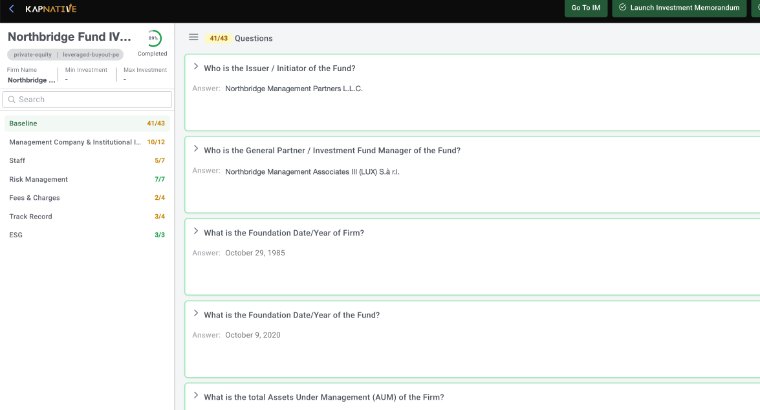
A live fund DDQ run. Section completion on the left, answered questions with their attachments and sign-off state on the right.
Coverage, critical knock-out questions and first source-cited answers, subject to data-room scope.
End-to-end process range, not software processing time. It depends on data-room completeness, manager response times and your own review steps.
Every draft carries a validation state: draft, manager-confirmed, analyst-approved or exception.
From quick screening to full due diligence.
{{ m.name }}
{{ m.scope }}
Six steps, each with a visible state.
Select a step to see what the workspace produces at that point - and what your team gets out of it.
{{ step.label }}
{{ step.desc }}
{{ step.note }}
Illustrative - anonymised fund, synthetic figures.
Read a full IC pack before you talk to us.
Anonymised and illustrative, with every important statement showing its validation status and evidence link - the same structure your committee would receive.
A writing assistant can draft. An institutional workflow must govern.
General-purpose models are useful, and analysts already use them. The difference is what a committee and an auditor can rely on afterwards.
A comparison of workflow properties, not of model quality. Kapintelligence uses large language models under contractual no-training terms; the governance around them is the product.
See Kapintelligence in action.
From fund due diligence to IC ready output.